
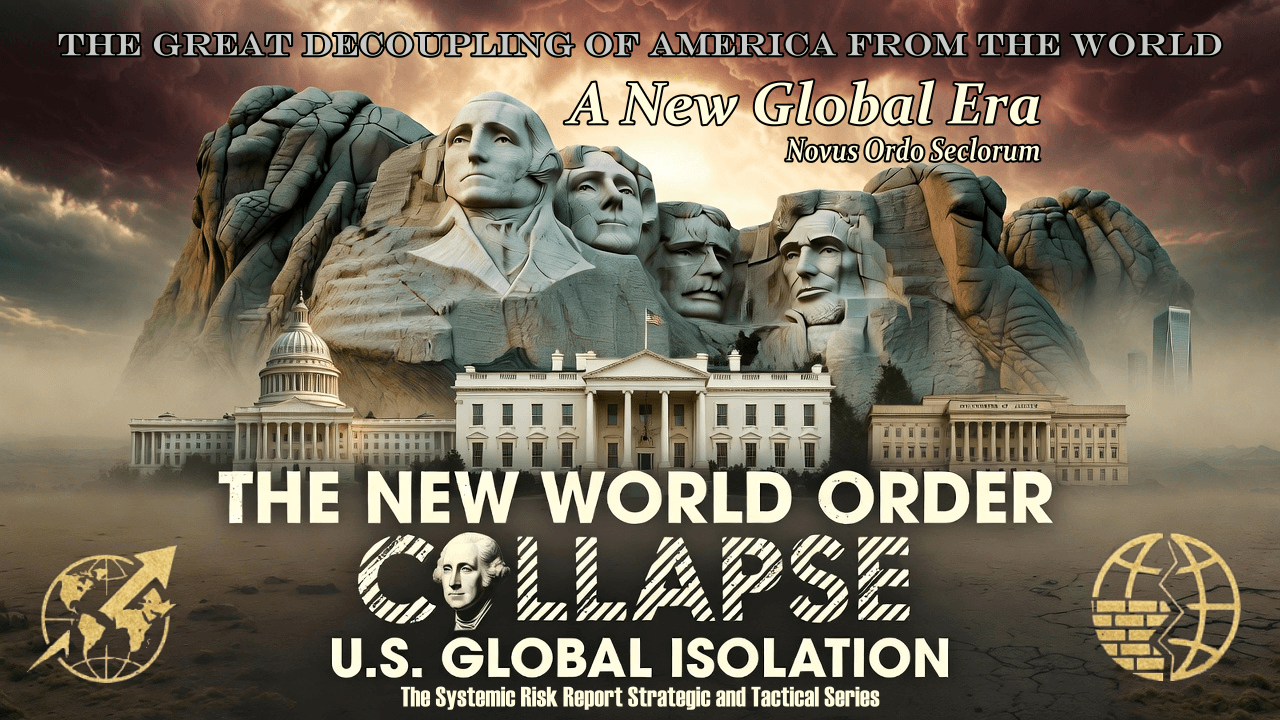
The New USSR: The United States of Statist Reorientation
Login to Publication for a full report.Over the past fourteen months, the United States has deliberately, methodically, and voluntarily dismantled the economic machinery that made your life affordable, your retirement possible, and your country the undisputed leader of the free world. And they did it while telling you it was "renewal."
Look, I'm not here to scream that the sky is falling. The sky already fell—we just didn't notice because it happened in executive orders, trade notifications, and quiet sanctions reversals while we were scrolling past headlines about Greenland and tariffs.
Here is the truth no one in Washington will tell you: over the past fourteen months, the United States has deliberately, methodically, and voluntarily dismantled the economic machinery that made your life affordable, your retirement possible, and your country the undisputed leader of the free world. And they did it while telling you it was "renewal."
This is not a story about China hacking our systems or Russia outsmarting our diplomats. It is a story about us. About how the second Trump administration—fully conscious, completely deliberate, and with meticulous planning—torched the three pillars of the American economy and called it patriotism.
THE THREE PILLARS: WHAT THEY TOOK FROM YOU
Every great power rests on three economic foundations. For the United States, those have always been: debt markets that let the world lend us money at laughably low rates; global fiat currency dominance that lets us borrow in our own dollars and pay our bills with a printing press; and commodity markets that ensure oil, grain, and gold are priced on our terms, not theirs.
Over fourteen months, this administration dynamited all three.
The First Pillar: Your Mortgage Just Got More Expensive
The United States carries $36 trillion in public debt. That sounds abstract until you understand that every single dollar of that debt is an IOU held by someone—pension funds, foreign central banks, your own retirement accounts. For decades, the world trusted us enough to lend us money at near-zero interest rates because they believed we would always pay it back and that the dollar would always hold its value.
That trust is gone. China has reduced its Treasury holdings by nearly half since 2013, from $1.32 trillion to $682 billion. Japan is quietly trimming. Saudi Arabia is selling. The petrodollar—the seventy-year bargain that kept oil priced in dollars and those dollars recycled into our debt—is dead. They are not dumping Treasuries in a dramatic fire sale; they are simply not buying more, and that silence is deafening.
What does this mean for you? It means the 10-year Treasury yield—the interest rate the government pays to borrow money—has climbed to 4.17 percent and is headed higher. Every loan in America is priced off that yield. Your mortgage, your car payment, your credit card, the loan your small business needs to meet payroll. Every time yields rise, your monthly payments rise with them. If yields hit 6 percent—and under current trajectories, they will—mortgage rates will approach 9 percent. That is an extra $1,000 per month on the average home loan. For a generation already locked out of homeownership, that door is now welded shut.
The Second Pillar: The Dollar Is No Longer the Only Game in Town
For eighty years, the dollar was the world's default currency. Countries invoiced their oil in dollars, held their reserves in dollars, and settled their trade in dollars. This "exorbitant privilege" allowed the United States to run massive deficits, borrow at favorable rates, and impose sanctions that actually meant something. If you wanted to do business with the world, you had to go through us.
That era is ending. It is not ending because China built a rival reserve currency overnight; it is ending because we handed Beijing and Moscow the crowbar and pointed them at the dollar's pedestal. By suspending sanctions on Russia, delisting oligarchs, and restoring Moscow's access to global finance, we signaled to every nation watching that America's word is now a revocable executive agreement. Sanctions are no longer irreversible. Commitments are no longer credible. The dollar's throne is now a rental property with a month-to-month lease.
Saudi Arabia now accepts yuan for oil. Brazil and Argentina are exploring a common trade currency. India and Russia settle energy deals in rupees. None of this happened because the alternatives were superior; it happened because we made ourselves unreliable.
The Third Pillar: We Gave Away Our Commodity Leverage
America is the world's largest food exporter. We feed billions of people. That is not just commerce; it is leverage. When we withdraw from USMCA and threaten to tear up trade agreements with our closest neighbors, we are not punishing Canada or Mexico—we are punishing American farmers. Our corn and soybean exports to Mexico are now vulnerable to Brazilian competition. Our dairy farmers are losing the Canadian market to Europeans and New Zealanders. Our beef producers are watching Australian suppliers take over Korea.
And while we retreat, our adversaries advance. Russia is consolidating its energy hold over Europe. China is locking in long-term commodity contracts across Africa and Latin America, denominated in renminbi. We are not just losing markets; we are losing the ability to price global commodities on our terms. The dollar's grip on oil and grain is loosening, and once it slips, it does not come back.
THE ALLIANCES WE BURNED
The economic pillars did not crumble in isolation. They were weakened by the same strategic virus that infected our alliances.
Consider what we did to our friends in just fourteen months. We notified Canada and Mexico that we were withdrawing from USMCA, the trade agreement we ourselves negotiated. We demanded Japan and South Korea renegotiate their Status of Forces Agreements, converting basing rights from enduring commitments into annual renewable leases with market-rate rent assessments. We told NATO allies that Article V—the solemn pledge that an attack on one is an attack on all—is now subject to annual budget negotiations and a 15 percent administrative surcharge.
We conditioned intelligence sharing with Canada on its defense spending percentage. We charged Australia $3 billion for technology transfers we had already promised. We reduced automatically shared intelligence categories with our closest Five Eyes partners by 40 percent.
And then we wondered why they started looking elsewhere.
Germany is now building a €40 billion European fighter jet with France and Spain instead of buying American F-35s. Japan established a ¥5 trillion defense industrial fund to build its own missiles and fighter aircraft. South Korea successfully test-launched a submarine-launched ballistic missile—a capability we spent decades preventing them from acquiring. Canada is building its own signals intelligence satellite.
These are not acts of betrayal. They are acts of survival. When your security guarantor tells you that your protection is now a service contract subject to annual renewal and rent increases, you do not double down on loyalty; you diversify your suppliers. That is exactly what every single one of our allies has done.
The transatlantic alliance has not been formally dissolved, but it no longer functions as a covenant. It is a transaction. And the trust that sustained it for seventy-five years—the trust that deterred Soviet armor and held the line through decades of Cold War tension—has been converted into line items and administrative surcharges.
THE ADVERSARIES WE EMBRACED
While we were burning bridges with our friends, we were building highways for our adversaries.
We normalized relations with Syria. We revoked Caesar Act sanctions and appointed an ambassador to Damascus—the first since 2012—without securing a single humanitarian concession or political reform. The Assad regime remains dependent on Russia and Iran, just as it was before we engaged. Our "engagement" achieved nothing except to signal that American sanctions are revocable at presidential whim.
We suspended sanctions on Venezuela without securing any commitment to free elections. Nicolás Maduro released no political prisoners, invited no international observers, and made no move toward democracy. He simply pocketed our concession and continued crushing his people. Chevron expanded production; Valero and PBF resumed lifting Venezuelan crude; and the Maduro regime pocketed billions in new revenue.
We released $3.5 billion in frozen Afghan reserves to the Taliban without requiring a single counterterrorism concession. Al-Qaeda operatives remain in Afghanistan, the Taliban's cooperation remains "minimal and conditional," and we have normalized engagement with a designated terrorist entity while pretending it is humanitarian assistance.
And then there is Russia.
THE RUSSIAN RAPPROCHEMENT: THE MASTERWORK
The normalization of relations with the Russian Federation is not a policy adjustment. It is a masterwork of self-inflicted strategic defeat.
Between December 2025 and March 2026, the United States systematically dismantled every major sanctions program painstakingly constructed since Russia's 2014 invasion of Crimea. Sovereign debt sanctions expired and were not renewed. Energy sector sanctions were suspended via three general licenses that restored U.S. companies' ability to equip and finance Russian oil and gas projects. Twenty-three Russian oligarchs and forty-seven entities were removed from the Specially Designated Nationals list, including VTB Bank, Sovcombank, and Rosoboronexport. Eighty-five entities were removed from the Commerce Department's Entity List, restoring their access to American semiconductors and dual-use technology.
All of this occurred without any measurable change in Russian behavior. The Kremlin did not withdraw a single soldier from Ukraine. It did not release political prisoners. It did not halt its cyber operations against American infrastructure. It simply waited, and Washington delivered.
The Istanbul Communiqué of February 26, 2026, represented the culmination. In a palace on the Bosphorus, the United States—without Ukraine present, without European participation, without consultation with NATO allies—negotiated terms that would codify Russian control of 20 percent of Ukrainian territory, foreclose Ukrainian NATO membership indefinitely, and release $300–350 billion in frozen Russian central bank assets with only a fraction designated for reconstruction. Ukraine was presented with an impossible choice: accept permanent territorial loss and security vassalage, or continue fighting without American support.
The communiqué has not been implemented. Ukraine has not agreed to its terms. But that is not the point. The point is that Washington demonstrated, for all the world to see, that it is willing to trade Ukrainian sovereignty for Russian cooperation. That demonstration cannot be rescinded. The trust deficit it created cannot be repaired by executive order.
WHAT THIS MEANS FOR YOUR WALLET
Let me bring this home. All of this—the trade withdrawals, the alliance conditionality, the adversary engagement, the Russian rapprochement—is not abstract geopolitical theater. It has a direct, measurable, and damaging impact on your household finances.
Your mortgage. The 30-year fixed rate is already at 6.16 percent. Every indication suggests it is heading to 7, 8, or even 9 percent as foreign buyers exit our debt markets and domestic investors demand higher yields to absorb record Treasury issuance. On a $400,000 home loan, the difference between 6 percent and 9 percent is $815 per month. That is a car payment. That is groceries for a family of four. That is the difference between owning a home and renting forever.
Your retirement. The classic 60/40 portfolio—60 percent stocks, 40 percent bonds—has been the foundation of American retirement savings for a generation. It worked because stocks and bonds moved in opposite directions; when the market crashed, bonds provided a safe haven. That correlation has broken. Bonds are no longer a safe haven because the issuer of those bonds—the United States government—is no longer considered a completely reliable credit. Your 401(k) is now exposed to geopolitical risk you never voted for.
Your cost of living. Every tariff we impose on trading partners is a tax on you. When we tax Canadian lumber, your home renovation costs more. When we tax Mexican produce, your grocery bill rises. When we withdraw from trade agreements and disrupt integrated supply chains, the cost of everything—cars, electronics, appliances, clothing—goes up. There is no foreign government paying these costs. You are.
Your job. American farmers have lost market share in Canada, Mexico, Korea, and beyond. American manufacturers are watching their export markets erode. American defense contractors are losing $20–25 billion in annual sales as European and Asian allies pivot to domestic suppliers. Those are not abstract corporate losses; they are lost jobs, reduced hours, and stagnant wages in communities across the country.
THE IRONY COMPLETED
The architects of "America First" promised to restore American sovereignty, renew American prosperity, and reassert American leadership. Here is what they actually delivered:
Sovereignty? We are less able to influence international outcomes than at any point since 1945. Allies no longer follow our lead; adversaries no longer fear our sanctions. We have traded influence for autonomy and received less of both.
Prosperity? Our trade relationships are in tatters, our debt trajectory is unsustainable, our currency's global dominance is eroding, and our cost of capital is rising. The three pillars of the American economy are cracked, and we are the ones holding the sledgehammer.
Leadership? The post-American strategic architecture is already emerging. Europe is building its own defense capabilities. Asia is integrating without us. The Gulf states have diversified their security portfolios. We are no longer the indispensable nation; we are one of several major powers competing for advantage in a world we no longer organize.
This is not a failure of execution. It is a failure of conception. A nationalism that mistakes retreat for renewal, that treats allies as clients and adversaries as partners, that dismantles the institutional architecture of American power while claiming to strengthen it—such a nationalism cannot succeed because it misunderstands the sources of American greatness.
Those sources were never merely material. They were the trust of allies, the credibility of commitments, and the conviction that American leadership, for all its imperfections, served purposes larger than the parochial interests of any single administration. That trust has been depleted. That credibility has been discounted. That conviction has been shaken.
WHERE DO WE GO FROM HERE?
The United States retains formidable advantages. Our economy is still the world's largest. Our military is still the world's most capable. Our universities still attract the brightest minds. Our currency, while challenged, remains dominant. We are not the Soviet Union, collapsing under the weight of our own contradictions. We are something stranger: a great power deliberately, methodically, and voluntarily disassembling itself and calling it renewal.
Three pathways lie ahead. Reconstitution—reversing the withdrawals, reimposing sanctions, rebuilding trust with allies—is legally possible but politically improbable. Adaptation—accepting our reduced role, preserving core interests, managing decline with dignity—is the most sustainable but lacks a political constituency. Acceleration—continuing on our current trajectory—requires no new choices and is therefore the most likely path.
The choice is not between globalism and nationalism. It is between a nationalism that understands interdependence and one that mistakes retreat for renewal. It is between a realism that recognizes the limits of American power and a realism that abandons the instruments of American influence. It is between a conservatism that values the institutions and traditions that have sustained American greatness and a radicalism that would dismantle them in pursuit of an illusory restoration.
The New USSR: The United States of Statist Reorientation. The title is a provocation, not a prediction. We are not becoming the Soviet Union. We are, however, adopting certain characteristics—strategic retreat, institutional erosion, fiscal fragility, and soft power decline—that were central to the Soviet demise. The difference is that the Soviets collapsed from exhaustion. We are collapsing from choice.
Your 401(k) is collateral for a geopolitical experiment you never consented to. Your mortgage is the line item for trade wars you never voted for. Your children will inherit a world where America is no longer the undisputed leader, where the dollar is one currency among several, where alliances are contracts to be priced and terminated rather than covenants to be honored.
This is not a prediction. It is a warning. The bus is still on the road, and the driver still has his hands on the wheel. The question is whether anyone in Washington notices that he is steering toward the cliff—and calling it renewal.